Showing posts with label writing advice. Show all posts

Tuesday, December 8, 2015

Outlines

Most authors outline, whether they admit to it or not. Even the most ardent "pantser" (someone who writes by the seat of their pants, making it up as they go) has a general idea, even if subconscious, of where the story's going at certain points.

I have been asked many times how I write, but haven't yet taken the time to explore the issue in the blog. I begin any story with a situation, a scenario similar to the blurb you'd read on the back of a novel. I have a journal with about twenty future book ideas, scenarios I've thought about and would like to expand on. I add to the list frequently, adding two new scenarios just this past week.

Scenario: Kid trains to be a Grim Reaper at a school where students learn how to reap souls. Reaping is a job, just like any other. Tensions exist at the school between Dragons- the original Reapers- and the Deaths, who now Reap. At end, kid must pass a test to go home.

The scenario will look something like the above, with no details fleshed out, and not much more clear. I then daydream about what will happen, and in this period, the most abstract creation occurs. As part of this stage, I develop what I call an "image outline." I develop a set of specific pictures, frozen images that I know are somehow related to my story, but I don't yet know how or even what order they'll occur in. 

I'm currently reading Ransom Riggs' novel Miss Peregrine's Home for Peculiar Children. The book combines authentic old photographs with an odd story about a boy traveling to a remote island off of Wales. I've read that Riggs collected tons of actual photographs and used them to inspire a storyline, which now spans multiple books as well as an upcoming film. 

I originally developed my inspiration for The Scythe Wielder's Secret (and School of Deaths in particular) from a trip I took to Tintagel. The original blog post from my trip can be found here. While I didn't have actual photographs to ply through or inspire me, I began to envision certain pictures in my head. Images I wanted to include in the novel.

Note: all prints below are by artist Jenn Eldreth and are available for purchase. Click on the pictures for more detail or to read a quote from the books about each.


One of the earliest images I envisioned, an enormous metal door in the center of an upward-flowing waterfall (or water-rise?) Didn't originally know what this would be, but it ended up playing a major role in the books. 

The Library I envisioned was partially inspired by the Duke Humfrey's Library Room in Oxford. This is the oldest reading room in the Bodelian and the college as a whole, and was a place I worked on the earliest drafts of School of Deaths. Admittedly, it's also where the library scenes in the Harry Potter films were filmed. I tried to differentiate from the Potter library by adding glowing flower lights and dozens of massive old stones.  

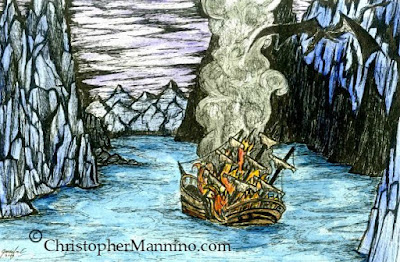
Before even starting book two- Sword of Deaths- I had a single strong image in my head.
A boat, the old fashioned schooner type, on an icy sea. The boat was burning and a Dragon circled overhead. Exploring this image internally helped me develop the plot line for Sword of Deaths. 

After I have an image outline, I start from the beginning and just keep writing, trying to connect images as I go. With my current work in process I'm in much the same situation. I have a clear number of images in my mind, but no idea yet exactly how all of them will connect, and what the final process will be.
   

Monday, August 17, 2015

Finishing a Trilogy

Yesterday I completed the first draft of Daughter of Deaths, completing The Scythe Wielder's Secret trilogy. This series of books has consumed my writing life for the past four years, and there is still the editing process and of course marketing.

Typing the final words of the novel was difficult. A sense of sadness crept into me, knowing that I'm not going to be working with a group of characters I've come to know and even care about. Watching the twists and turns of this plot and seeing the characters grow and develop from simple ideas to complex entities has been immensely rewarding. I am excited to see how the three novels are received by the public, once all three are published. And of course, I now move on to many new and exciting books and genres.


Monday, June 15, 2015

Characters and Targets

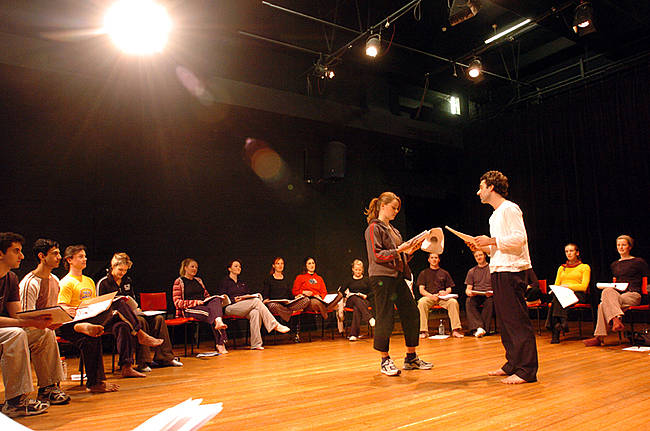
As an acting and theatre teacher, I spend a lot of time working with young actors on discovering their characters' targets.

Depending on which acting methodology a person uses, they might refer to these as various things. A target encompasses a character's objective, their goal, and relates to their superobjective. I like the term target, first introduced to me in Declan Donellan's "The Actor and the Target" because it provides a concrete image of what you're aiming for when onstage. I strongly encourage all my actors to always have a specific target in mind. Acting is about doing, so every time an actor is onstage, there is something that they want, a target the character is working towards. For example, Romeo's target at the beginning of Romeo and Juliet might be relief, he vents to his friends about his girl problems. Later, his target becomes Juliet herself.


Thinking about targets is especially useful as a writer. Every writer has strengths and weaknesses. Personally, one of my greatest strengths tends to be creating memorable environments and locations. I can envision drastic, imaginative settings, and describe them well. However, setting is only one part of a story. One thing I've been doing lately, is when I'm crafting a scene I go through and take some time to check every single character's target.


Even in a battle scene with hundreds of characters, every single figure has their own unique target. Every one wants something, and will go towards that goal until they get it, or their target shifts. Characters can share targets, but I find it helpful to think of each character as an individual who wants specific, different things. One figure in a battle scene might fight for revenge, another to prove himself to a parent, and another for money. But they're all fighting on the same side.

Go through whatever you're working on. Do you know your main character's target on every page? Do you know the targets of every minor and background character? Try adding targets to make your writing more detailed.

Monday, February 9, 2015

Rest

Several weeks ago, my wife gave the sermon for our church retreat "Winter Escape." One of the subjects she addressed was the issue of rest. She cited a number of researchers and statistics that discussed how, as a species, we have developed the technology to be the most leisure-based society: the group that rests for the largest percentage of our time. However, the majority of working people tend to feel overworked.


I'm no exception. An eight-hour work day is a light day for me. As I type, I've already been at work (the school I teach at) for eleven hours, and yes I'm sneaking a minute from work to do some blogging- a different job, but still a form of work. 


Overwork and stress are the single biggest enemies to the creative mind. A writer might force themselves to sit at their computer for seven hours a day, but are they writing well?  The important thing isn't even to just get rest, the critical detail for a writer is to have enough to actually daydream


I remember a music theory class I took in college, where the teacher insisted the only important thing in one piece we were studying was the rests. In the creative process, the mind needs time to build, to dream. Forcing an overworked mind to pump out information, doesn't lead to better creation, or even necessarily to more creation.


Every time I sit down to write, I try to spend at least a half hour thinking of nothing. I let my mind wander. Perhaps I'll go on a walk, or perhaps I'll meditate. If I don't have time during a busy workday to have this creation time, I still spend at least ten minutes before I sleep allowing my mind to go anywhere. Little by little, the fires of the creative process are fanned, and the creation improves.

What moments of rest work for you?

Monday, August 4, 2014

Magic: Part One

Nearly every fantasy author wrestles at some point with the issue of magic. This will be a 2-part entry, discussing magic in fiction.


Loosely defined, magic is anything which isn't possible in the universe we know. It often involves special powers and the ability to bend the laws of physics. In Fantasy literature magic is extremely common, and even alluring. Many readers turn to certain books, movies, or television programs because they enjoy pushing the limits of what is and isn't possible. 

Magic makes anything possible.   

The first question an author needs to address if using magic in their world is what are the limits and costs of magic? Does the magic in your world have restrictions?  A character who can perform limitless magic, with no cost, is usually called a god. These characters have been popular in literature since Ancient times.  Homer wrote about the gods, just as teens go to the movies to watch Thor. In other fantasy novels, some characters have different limits or different costs than other characters.

1. Limits

Limits are boundaries as to what magic can or cannot do. Since magic essentially replaces the laws of physics, the question that arises is are there other laws or rules which govern how magic works in your universe? Let's look at a few concrete examples of what magic can/cannot do in some examples of popular fiction.


The X-Men, pictured above, probably aren't the first group of fictional magicians who spring to mind, but as characters able to completely bend or alter the rules of physics, these figures all practice their own form of magic. They're also uniquely limited. Each mutant has one power, that only they can do. Wolverine cannot read minds, and Magneto doesn't control lightning. Stan Lee devised a world where the magic is limited by dividing it equally among characters. Everyone has one gift, and nothing else. This works well in confrontational situations, where powers clash. This is the basis for many superhero stories. Other authors who divide their magic to create limits include Piers Anthony's Xanth books, where each character has a single "Talent" and is unable to do any other type of magic. Michael DiMartino's Avatar the Last Airbender series is an example where entire nations possess a similar magical ability, and the different nations clash. A fire-bender controls fire, whereas a water-bender controls water and so on.


Another option, if limiting magic, is to choose things that magic simply cannot do. In Disney's version of Aladdin, the genie pops out of the lamp, filled with magical potential, and immediately tells Aladdin there are "rules". There are things he cannot do for Aladdin, which in that case include bringing back the dead, making people fall in love, or granting unlimited wishes. It's one of the clearest and most concise examples of a magician spelling out the limits of magic in his world. It's important to make sure your rules coincide with your plot. If Aladdin wishes for unlimited wishes, he becomes a god. If he makes Jasmine fall in love with him, the entire point of the movie ends. And of course, if he brings the dead to life, Disney probably won't make the movie. An alternate take on putting strict limits on what magic can do, is to put an internal limit, as to what the magician is willing to do. In Christopher Paolini's Eragon series, for example, the magician Ergaon has the ability to draw energy (which he needs for magic) from living things around him. He is unwilling to kill those things, which adds depth to the character, while also adding a slightly fluid barrier to the limit of his magic.

It is, as was mentioned, a viable option to have limitless magic. If an author goes this route they often put limits somewhere else. The most popular books about magic ever published introduces a world with nearly limitless magic. 


The scene pictured above, from the film adaptation of Harry Potter and the Goblet of Fire, is one of the scenes where JK Rowling discusses the three "forbidden" curses in the Harry Potter world, namely the powers to torture, control against one's will, and murder. These three curses are limits, yet it's important to note that all three are used by characters in her books. In other words, the ability to use this type of magic not only exists, but is necessary. In Harry Potter, there is only one specific limit given to magic, which is that magic cannot bring the dead back to life. All other magic is possible, so Rowling employs laws which restrict the uses of magic. She's added limits to the characters, since the world is nearly limitless. 

If an author creates a world where magic is limitless or nearly limitless, they often create limits elsewhere. One such mechanism is to increase the cost of magic.

2. Costs

Prince Allan stares at his four remaining fingers, trembling. He remembers the terrible pain, but he has no choice. He closes his eyes... 

In the above example, which I just made up, a character is born with the ability to use magic whenever he wants. His magic is limitless, yet the cost is specific. Each time he casts a spell, he loses a finger. He can therefore only use magic ten times. Hopefully he uses his powers well.

In your world, it's important to know the cost of using magic. Often there is a penalty. To return to the Eragon example, in Alagaesia (Eragon's world), the cost is life energy. If Eragon casts a powerful spell that never ends, he will die. If he's weak he has to either draw energy from somewhere else, or wait until he's healed to cast the spell. In George R.R. Martin's Song of Ice and Fire the cost of potent magic is royal blood. This helps propel several plotlines, especially around the figure of Stannis. The magic used is literally blood magic, coming at a dire cost. In video games and anime, many worlds incorporate an actual monetary cost. If you have enough money, you buy a spell. The more money you have, the greater your power will be.


The cost of magic doesn't have to be external. In Tolkien's Lord of the Rings, Frodo offers Gandalf the One Ring very early in the story. Gandalf refuses, as do later characters, saying that if they used the Ring's power to overcome the villain Sauron, they would be turned to evil. The cost of using the Ring is to lose oneself. Similarly, in the Star Wars universe, Jedi have the ability to use the Dark Side of the Force. Yet doing so turns them evil, as is the case when Annekin becomes Darth Vader after using the Dark Side. 


If magic doesn't come with a cost, can anyone use it? To return to Hogwarts and the Potter world, there is no cost to magic in Rowling's world. A student can spend all day at school, and if they know all the words, they can cast a thousand spells with no repercussions. To compensate for what would otherwise be a series about a god going to school to train with other gods, Rowling tells us that only certain people can use magic, people born as wizards. They must also use magical extensions, such as wands in order to facilitate their power. In other series, Rick Riordan's Percy Jackson, who is himself an actual demigod, is limited by his human emotions. At the end, when he is offered godhood, Jackson declines, in favor of a mortal love.

As a fantasy author, there's no right or wrong way to do magic. Magic can be limitless, or be so controlled that its nearly impossible to use. Magic can have no cost, or have a cost so high, you fear using it. What if the cost of magic was the life of your child? Would you use it? What if magic could do anything at all, except the one thing your protagonist needs?

Fantasy opens all of these possibilities and more.

The discussion of magic will continue next week...

Monday, June 30, 2014

Playwriting vs Novel writing

Today I'd like to talk a bit about the differences between writing plays and writing novels. I don't think either one is easier than the other, and there are some things to keep in mind if you try to switch from writing one to the other.

Difference one: Directing

With a novel, you are the director.  When you sit down to write the story, you control everything. If you want a character to do, feel, think, or act in a certain way- they do. You push the pen (or keyboard) and the character jumps. You even control how they look, smell, talk, and so on.  A novelist is more than a director, they're the god of their world, pulling every string to weave the tapestry of their story.  Many claim they let the characters "tell them" what to do as they write, but whether consciously or not, it's still all in the author's hands.  Even an editor who steps in to mention things that need tweaking, ultimately gives it back to the author to tweak.  John Doe might need to scream, running away from a burning building in a scene, but won't until the author orders him to.

On the other hand, a playwright might have an idea of how a play should look, but ultimately they will probably not direct it.  Yes, some playwrights direct their own scripts, but eventually that script should leave the playwrights' hands.  Theatre is an organic art, created by groups instead of individuals.  A playwright creates a situation and dialogue, but it's a director who interprets that dialogue, and actors and designers who bring the interpretation to life.  One thing I constantly remind my playwriting students is to avoid drafting too many stage directions, as blocking is the job of others.  If John Doe says help, the word comes from the playwright. The choice to scream for help comes from the actor. Screaming for help while sprinting across stage comes from the director's blocking, and the burning building collapsing overhead comes from the director, designer, and stage hands.  The words belong to the playwright, but the theatrical presentation comes from a group effort, not an individual.  For many authors used to total control over a world, this is intimidating.  Novel writing involves growing a garden, picking the vegetables, and cooking a meal. Playwriting is planting seeds and watering, trusting others to harvest.

Difference two: senses

People have five senses.  One advantage of novelists is the ability to create a world that touches all five senses.  Bob walked to the store with the red awning, basking in the warm sunlight. He sat, smelling the fresh sesame bagels. Taking a bite, he heard a dog bark behind him.  Characters experience all five senses, and details incorporating all of the senses help to create a more vivid and realistic world.  Not only can all senses be described, but internal reactions can accompany a sense.  I pulled the fork to my lips and gagged, revolted at the bitter taste.  

However, all of the above is an illusion.  In reality, books only enter a reader's mind through ONE sense. Every sense mentioned above traveled to your brain through sight.  If you're listening to an audio book, you only hear the words and nothing else.  In theatre, we use a combination of visual and auditory stimulation simultaneously.  You hear and see everything happening onstage.  Experimental theatre pushes the boundaries of sensory experience even further.  Here in Washington DC, the theatre troupe "Dog and Pony" uses a blend of audience interaction, tactile objects, and a pre-show buffet styled after the production, to engage every sense. In their show Beertown, for example, the townsfolk enjoy an assortment of desserts and dishes, while talking to the dignitaries of the town (actors) about a series of objects to be voted on as part of the interactive show.  No author could fully engage his audience more thoroughly, no matter how many senses were written about.  Even in traditional theatre, the actors themselves can experience the world of the play through sight, sound, touch, and sometimes smell and taste.  In a production of Inherit the Wind, I had deliver a monologue between bites of fried chicken.  My reality of the story was heightened, in turn heightening it for the audience.     

Difference three: the bubble

The final difference I'll discuss lies in the process of creation itself.  Writing books, for most authors, is a solitary business.  There might be research or collaborative discussions in a writing group, but ultimately the author lives in a bubble, dreaming of his or her world.  Many authors cannot ave any distractions, and can only write when the walls of this bubble are thickest.

To be fair, there are some playwrights who write the same way. They sit in isolation, crafting dialogue and imagining a vision for the stage.  Yet, since theatre is an organic art, created by groups instead of individuals, many plays take shape in group settings.  If you're writing a musical, you work with a composer and librettist to craft a work.  Other pieces are based on a collaboration between you and and ensemble.  When I met Rachel, she worked at Woolly Mammoth Theatre Company, a space devoted to only premiering and workshopping new plays.  After every premiere, the producer, playwright, and director all came out and asked the audience what elements worked and didn't work.  In a way, the audience played a role in editing and drafting the final version of the production.  Other plays are more collaborative from the beginning.  Director/playwright Mary Zimmerman made a name for herself by watching her theatre troupe improvise based on a situation, and then crafting dialogue based on the improvisations.  In those situations the playwright has no bubble at all.

What are your thoughts?  Have you considered switching from novels to plays?

Monday, May 19, 2014

How Acting Helps Writers

As readers of this blog know, my biggest passions are writing and theatre.  I've been involved with stage theatre since I was a young child, and consider theatre to be my home.  Two weeks ago, during a series of interviews (which can be found here: christophermannino.com/about-the-author.html ) I was reminded that my writing process is more disjointed than some writers'.  Because I only write part-time, I don't have the time to sit down and develop a full story from start to end without pausing.  I now realize that my success as a writer is due in large part to my background as an actor.  I recommend anyone who writes, especially if they work another job, should try out for a play.  For those worried about performing, try community theatre- no prior experience needed, and no pressure.  Here's how theatre can help your writing:


1.   Theatre in a non-linear process
If you don't have time to write a book from start to stop, you're not alone.  Part-time writers need to be able to write their story whenever they get a chance- picking up the story wherever they left off.  My advice: become an actor in a play.  The more shows you're in, the more you'll get used to thinking non-linearly.  Even if a play takes place in chronological order, you never practice a show like that.  You'll pick up in the middle, work one scene, then start a different scene.  You need to be able to keep the chronology of a play in mind when starting in the middle.  Eventually this skill becomes second-nature, and will allow you to pick up a draft in the middle with no trouble at all.

2. Theatre builds dialogue skills
Have trouble writing believable dialogue?  Plays and musicals are nothing BUT dialogue.  You get used to language in a new way, by not just speaking it, but practicing speaking in different ways.  This builds skill at writing and using dialogue effectively in any setting.  Trying to incorporate appropriate methods of speaking into your characters voices can be very helpful.

3. Theatre builds confidence
A number of authors at Muse It Up have mentioned feeling hesitant about in-person events.  The image of a reclusive writer, afraid of the world, is perhaps overblown, but to be fair- writing is an insular process.  What better remedy to isolation than jumping onstage in front of strangers.  Sound terrifying?  In a way, it's not you up there at all.  Drama provides a "mask" - in that it's your character onstage, not you at all.  If I was aked to read a script onstage I feel fine, but if I was aksed to tell my own story I might get nervous.  I reach into myself, and draw on that "mask" - becoming the character of myself.  It alleviates any nerves I might feel.


For all those reasons, plus the pure fun of it, give yourself something new to try- and go audition for a play.  Here's my school's website- to give an example of what I do with my drama kids: http://itshotaspancakes007.wix.com/rooseveltdrama

Finally, if you haven't entered yet- the contest is on!  Entries have started coming in, some silly, some amazing.  Can you name a Dragon?  

Enter a suggested name and you might see your Dragon in print!
Details: http://www.christophermannino.com/events-and-contests.html

Monday, March 17, 2014

Chutes and Ladders: Part Two


In my last post, I discussed the role of chance in our everyday lives.  Today, I look at the role of chance in writing.

Today is St. Patrick's day.  I remember as a kid, looking through our yard for a four-leaf clover.  I never found it.  When I was in kindergarten, my mother pointed to a rainbow in the sky, and told my brother and I that we'd go look for the pot of the gold at it's end.  We jumped in the car, full of excitement, but never seemed to catch the end of that magical arc of colors.  How many people look for a little token of control- something to change the roll of fate's dice in their lives, and reduce the amount of chance?
However, whether you believe entirely in chance or not, there's one arena where chance needs to be both absent and always-present: fiction. Perhaps the only place where there is no chance, no fate, and no luck at all is within the world of fiction.  Getting published, or making lots of sales- that's a different matter.  I'm referring to the world of the novel itself.    
Like most authors, I started my novel with an abstract idea.  This led to a rough outline, then a first, second, and third draft...  eventually to line edits, content edits, and currently a galley review.  There isn't a word in my novel that's in there by chance.  There's not a single thought that hasn't been evaluated and studied, not just by me, but by my early readers, my editors, and my publisher.  This novel, and indeed all novels, is meticulously planned out.  However, it still needs to give the illusion of chance.  I need my readers to believe that some of the events happening to the characters are random.  If you want a storm to blow over your setting, for example, that storm needs to appear from nowhere.  Or perhaps a character dies randomly- it happens in both real life and fiction, the difference is that fiction only appears random.

One of the clearest examples occurred in a TV program I enjoy: Downton Abbey.  In the finale of Season 3, the authors of this popular drama set up an idyllic vision.  Matthew and Mary were finally united, after overcoming every obstacle imaginable.  Then, in the final minutes of the episode, Matthew suddenly died in a car crash.  Everything was perfect, and one heartbeat later, everything's misery. This takes careful planning to pull off successfully, yet if done properly it shows chance in a world where nothing happens by chance.


The method employed by Donwton works well in fiction as well.  Engage the audience's attention thoroughly in the opposite direction you intend to take them.  Then throw your curveball.  If you truly want an event to seem random, avoid foreshadowing it, or keep foreshadowing to a minimum.  You, the author, know what's around the corner, but you want the reader staring staring straight down the road.  That way, when your plot twist comes leaping out, the reader is blindsided and thinks its purely chance.  Keep in mind, however, that not every event is chance, even in your novel.  Just like in reality, if there's an internal choice, it still should follow the character's rationale.

That's my thoughts on chance.  I also have some major news for my novel.  The cover is out, and I have a release date of May 2nd.


In preparation for this release, I have written a short story set two years before the novel.  SHADOW OF THE SCYTHE- the story of a French boy brought to the World of Deaths.  Download a FREE copy of Shadow of the Scythe at my website:  http://www.christophermannino.com/free-reads.html

On a final note, if you enjoy chance- you now have an exciting chance to win a FREE copy of my upcoming novel School of Deaths (the full novel).  This sweepstakes runs through April 1st.  

Sunday, February 23, 2014

What's in a Name?


Like many first-time authors, I'm caught in the middle of two pulls. The excitement of landing a publishing contract and launching a writing career wrestles with the fear of remaining anonymous, the fear that none will read my novel. Though the book hasn't even been published, with a website in my name and increasing social media presence I decided to Google search myself. I was surprised.

Who am I?
I showed up on the list, and my site ChristopherMannino.com was there as well, albeit number seven. The first hit was for a Chris Mannino who had died (ChrisMannino.com without typing Christopher- brings you to a memorial website) then there was an agent in Tennessee, a doctor with malpractice charges, and on and on... All this under a selection of mug-shot images, none of which was a picture of me.  My name is a common one, not a name I chose myself of course, but still I found this slightly disturbing. How can I make a name for myself, when I don't even have exclusive use of my own name?
I then started thinking less about my own name, and more about my characters. I;m not going to change my name, but every character name is completely up to me. In my first (unpublished) novel, I spent weeks and weeks agonizing over the perfect names.  In my earliest drafts, characters would talk to NAME1 or NAME2, since I couldn't bear to label any of the figures permanently.  

In School of Deaths, the main character was originally Billy Black. Black is a color associated with death and darkness, and I liked the alliteration. Billy is a name for a kid, a fun name. Then I switched the novel so it was told from a girl's perspective. I'm not completely sure where Suzie Sarnio emerged from as a name, perhaps a tribute to my own Italian heritage. 

Sometimes naming a character appropriately can be strange. In School of Deaths, a minor character is a figure called Athanasius. Athanasius is a goat-like figure who welcomes Suzie to the College of Deaths. His eyes are yellow like a lizard's, his face and hands look like a goat. He is the first Elemental Suzie meets; the Elementals are one of the major species in my world. After naming him, I went to see an eye specialist. The doctor's name, as he greeted me, was Athanasius. As the ophthalmologist examined me, I couldn't help but envision a pair of yellow lizard eyes staring at me, and hands like a goat's....

How do you name characters?  

Saturday, February 15, 2014

Wants and Goals

As Valentine's Day rolls by I turn my attention to desires.  


For many years, one of my greatest wishes was to find love.  Like many singles, I used to spend Valentine's Day utterly miserable, trying to ignore all my dating friends.  I'd pretend I didn't see the glut of commercialized "love" shoved at everyone through TV, movies, and the internet.

I am fortunate enough to have found my soul mate.  In fact, this was the best Valentine's Day I've had so far.  Thanks to a snowstorm and President's Day, Rachel and I enjoyed a full 5-day weekend together.  We made homemade chocolate-dipped strawberries, had dinner at one of our favorite restaurants, enjoyed an in-home couples' massage, and best of all we wrote our wedding vows.  My goal of finding love has come true.

For Young Adults, both in reality and in fiction, goals and wants are not always straightforward.  As an author and teacher, I think it's important to note how many kids have goals that are forced on them by parents, peers, or even society.  The school where I work is a particularly strong example.  Roosevelt is a science and tech magnet school for the entire county.  It has a huge arts program, including the massive theatre department I run, but ultimately most of the top kids who attend the school do so to take part in the advanced science courses.  It is not a vocational school, but does provide intensive internships at places such as NASA (which is a block up the street), the National Institutes of Health, the FDA and other federal research facilities around the DC area.  

Every kid has at some point been asked the question "what do you want to be when you grow up?"  Personally, I think it's a terrible thing to ask, especially to younger kids.  Who really knows their career path as a kid?  Still, it's such a cliche question, I ask it myself.  Before I started teaching at Roosevelt the answers I'd hear were usually along the lines of "I dunno, maybe a lawyer."  Now, I hear "I plan to specialize in bioengineering and microecology."  You're fifteen, I respond in my head.          

However, that's just the problem.  The better I get to know my students, the more I'm realizing that they say they want one thing, but in truth have no idea.  Society today has moved far away from the idea of a person going to college with one major, getting one internship or apprenticeship, and working one career until retirement.  I don't actually know anyone in my generation who has done that, yet our schools are becoming more and more geared towards this antiquated ideal.  Now, students are required to take large numbers of their college courses while in high school (AP Courses), they often have to apply to extremely restrictive majors, and if they don't go to college, their parents and some of their teachers will emphasize their lack of success. What are we teaching kids?  We're ultimately forcing them to have goals, whether they're ready to or not.


Of course a goal is not the same as a want.  Perhaps the question shouldn't be what do you want to do when you grow up, but rather what is the goal you are currently adopting for yourself.  For example, one of my students came to me very upset two weeks ago.  She is a strong actor, and had told me how much she wanted to keep acting, even if it was just for fun.  Acting and theatre was a true want, something she desired to do.  Her parents wanted her to stop acting, since the time it took was interfering with what they wished her goals to be.  Her goal was to have a successful career and be happy.  Ultimately, goals need to intersect with our wants to be successful.  

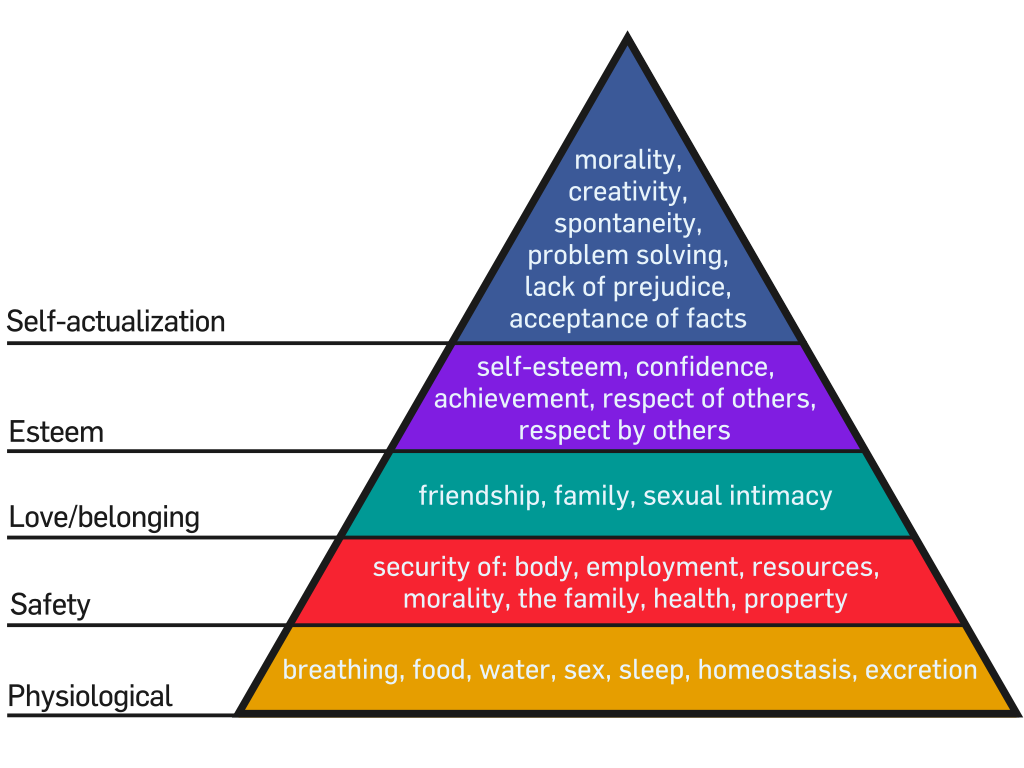
When writing YA characters it's important to keep the characters' goals and wants in mind, but recognize how severely society (or whatever the situation of your story might be) will impact them.  It seems that often we ignore our own wants in pursuit of our goals.  One must also keep needs (a separate category entirely) in mind.  In my upcoming novel School of Deaths, Suzie's primary goal for much of the novel is to go home.  Yet she soon finds herself in situations where other needs take precedent.  Safety is a basic need, and when Suzie's safety is threatened, going home becomes a want, while finding safety becomes her current goal.  Maslow's famous "hierarchy" works just as well for fiction as it does for life, with needs on the bottom of the chart needing to be met first:

Maslow's Hierarchy

   
Goals will shift in a novel and in life.  To return to the question of what to do when you grow up, I've now noticed that students will answer differently depending on who they are with.  The answer they give me when alone will be different than if a parent is standing there, and different again if in front of their friends.  This isn't necessarily deceptive, since a child's goals for one group might be different for another.  This too should be kept in mind when developing a YA character.  The goals they relate, and even believe in, are dependent on their circumstance and situation, yet should remain consistent nonetheless.  This is a simplification of life.  It is expected in fiction, but in life doesn't always follow.  For example, Suzanne Collins' character Katniss has several goals throughout the Hunger Games novels, yet the goals almost always relate to protection (protect her sister, protect herself, and eventually protect society itself from a corrupt government).  Katniss is a strong character because her goals remain consistent.  Do actual teens remain consistent in their goals or wants?  Often the answer is an absolute no.  If that is the case, perhaps fiction is one way even our authors are trying to encourage kids to stick with one goal, and one path.  I don't agree with it in life, yet I find myself drawn to the same conventions in my writing.  I like my characters to stay strong, and to remain consistent with the types of goals and wants they pursue.

To avoid having a character desire the same goal in every situation (something no true teen would do), I think it's helpful to write out a separate goal sheet for each character and break it into circumstances.  Roald Dahl's Matilda for instance has a very different goal in mind when dealing with Trunchbull than she does with Ms Honey, and a separate goal set again when dealing with her parents.  When teaching acting we focus on objectives and superobjectives that a character has in every scene.  Goals and wants are not much different, the one important detail to remember with kids is that they're rarely truly sure.  In a sense kids are trying goals as they mature.  Ones that work are kept, ones that don't are abandoned.  The closer a goal is to the kids' wants or basic needs, the more passionately they'll pursue the goal, and the more a goal is instilled from an external source, the more likely they are to abandon it at some point.  

With that in mind, back to my next goal: more writing!