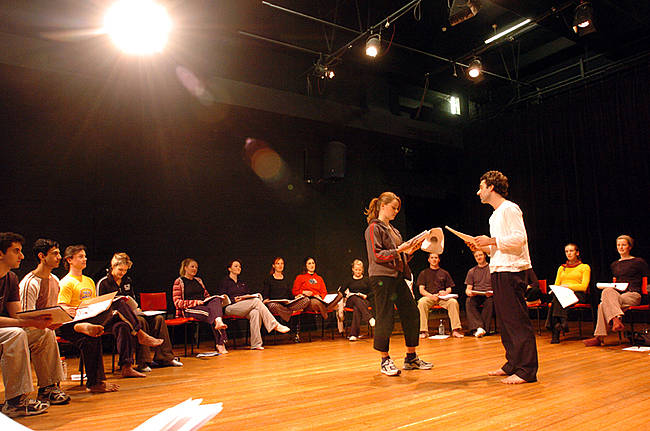
Lately I have had a lot of posts about writing. But what happens when thirty teenagers are asked to write an original play? The most challenging thing I've attempted at my job as a high school theatre teacher was to try just this feat.
I came to school in August, and told the kids I wanted them to put on an ensemble show. They'd work together to create an original script, and would all perform in it. The students voted to adopt the story of Aladdin, using an aesthetic of Israel and Palestine.
The show was a struggle to mount. Students had conflicting opinions on the direction of the story, the types of characters, or the overall plot. As an author, it's solely up to me to decide what my characters do and how the plots unfold. To have thirty teens arguing over this was no easy task.
I gave the kids projects, including writing short scenes, monologues, music (non-verbal) scene work, and slam poetry. Many of these elements ended up becoming part of the final process. We worked with a professional choreographer from a local theatre to develop new movement techniques, and with a professor from George Washington University to research the political issues.
Then the hurdles hit... ten missed rehearsals for snow/weather. Eleven students deciding two weeks before the show that they'd rather fail the class than be in the performance, and seven kids kicked out of Tech (backstage theatre) for pot (out of ten kids total in Tech). Plus, we got a new space- a huge abandoned tech room which is the new drama room, and we're converting into a blackbox theatre. It's exciting, but we moved into the space exactly one week before the show opened!
Despite the hurdles, the show was an overall success. Audiences enjoyed seeing the student's dark take on an otherwise light fairy tale, and were very impressed by how the show worked as a cohesive piece. Two alumns of Roosevelt drama each said it was one of the more ambitious and impressive shows they'd seen at the school.
And now it's spring break, and I am relieved to be writing alone- not thirty voices arguing, but just my own voice going to the page...
Showing posts with label Theatre. Show all posts
Monday, April 6, 2015
Monday, June 30, 2014
Playwriting vs Novel writing
Today I'd like to talk a bit about the differences between writing plays and writing novels. I don't think either one is easier than the other, and there are some things to keep in mind if you try to switch from writing one to the other.
Difference one: Directing
Difference three: the bubble
The final difference I'll discuss lies in the process of creation itself. Writing books, for most authors, is a solitary business. There might be research or collaborative discussions in a writing group, but ultimately the author lives in a bubble, dreaming of his or her world. Many authors cannot ave any distractions, and can only write when the walls of this bubble are thickest.
To be fair, there are some playwrights who write the same way. They sit in isolation, crafting dialogue and imagining a vision for the stage. Yet, since theatre is an organic art, created by groups instead of individuals, many plays take shape in group settings. If you're writing a musical, you work with a composer and librettist to craft a work. Other pieces are based on a collaboration between you and and ensemble. When I met Rachel, she worked at Woolly Mammoth Theatre Company, a space devoted to only premiering and workshopping new plays. After every premiere, the producer, playwright, and director all came out and asked the audience what elements worked and didn't work. In a way, the audience played a role in editing and drafting the final version of the production. Other plays are more collaborative from the beginning. Director/playwright Mary Zimmerman made a name for herself by watching her theatre troupe improvise based on a situation, and then crafting dialogue based on the improvisations. In those situations the playwright has no bubble at all.
What are your thoughts? Have you considered switching from novels to plays?
Difference one: Directing
With a novel, you are the director. When you sit down to write the story, you control everything. If you want a character to do, feel, think, or act in a certain way- they do. You push the pen (or keyboard) and the character jumps. You even control how they look, smell, talk, and so on. A novelist is more than a director, they're the god of their world, pulling every string to weave the tapestry of their story. Many claim they let the characters "tell them" what to do as they write, but whether consciously or not, it's still all in the author's hands. Even an editor who steps in to mention things that need tweaking, ultimately gives it back to the author to tweak. John Doe might need to scream, running away from a burning building in a scene, but won't until the author orders him to.
On the other hand, a playwright might have an idea of how a play should look, but ultimately they will probably not direct it. Yes, some playwrights direct their own scripts, but eventually that script should leave the playwrights' hands. Theatre is an organic art, created by groups instead of individuals. A playwright creates a situation and dialogue, but it's a director who interprets that dialogue, and actors and designers who bring the interpretation to life. One thing I constantly remind my playwriting students is to avoid drafting too many stage directions, as blocking is the job of others. If John Doe says help, the word comes from the playwright. The choice to scream for help comes from the actor. Screaming for help while sprinting across stage comes from the director's blocking, and the burning building collapsing overhead comes from the director, designer, and stage hands. The words belong to the playwright, but the theatrical presentation comes from a group effort, not an individual. For many authors used to total control over a world, this is intimidating. Novel writing involves growing a garden, picking the vegetables, and cooking a meal. Playwriting is planting seeds and watering, trusting others to harvest.
Difference two: senses
People have five senses. One advantage of novelists is the ability to create a world that touches all five senses. Bob walked to the store with the red awning, basking in the warm sunlight. He sat, smelling the fresh sesame bagels. Taking a bite, he heard a dog bark behind him. Characters experience all five senses, and details incorporating all of the senses help to create a more vivid and realistic world. Not only can all senses be described, but internal reactions can accompany a sense. I pulled the fork to my lips and gagged, revolted at the bitter taste.
However, all of the above is an illusion. In reality, books only enter a reader's mind through ONE sense. Every sense mentioned above traveled to your brain through sight. If you're listening to an audio book, you only hear the words and nothing else. In theatre, we use a combination of visual and auditory stimulation simultaneously. You hear and see everything happening onstage. Experimental theatre pushes the boundaries of sensory experience even further. Here in Washington DC, the theatre troupe "Dog and Pony" uses a blend of audience interaction, tactile objects, and a pre-show buffet styled after the production, to engage every sense. In their show Beertown, for example, the townsfolk enjoy an assortment of desserts and dishes, while talking to the dignitaries of the town (actors) about a series of objects to be voted on as part of the interactive show. No author could fully engage his audience more thoroughly, no matter how many senses were written about. Even in traditional theatre, the actors themselves can experience the world of the play through sight, sound, touch, and sometimes smell and taste. In a production of Inherit the Wind, I had deliver a monologue between bites of fried chicken. My reality of the story was heightened, in turn heightening it for the audience.
The final difference I'll discuss lies in the process of creation itself. Writing books, for most authors, is a solitary business. There might be research or collaborative discussions in a writing group, but ultimately the author lives in a bubble, dreaming of his or her world. Many authors cannot ave any distractions, and can only write when the walls of this bubble are thickest.
To be fair, there are some playwrights who write the same way. They sit in isolation, crafting dialogue and imagining a vision for the stage. Yet, since theatre is an organic art, created by groups instead of individuals, many plays take shape in group settings. If you're writing a musical, you work with a composer and librettist to craft a work. Other pieces are based on a collaboration between you and and ensemble. When I met Rachel, she worked at Woolly Mammoth Theatre Company, a space devoted to only premiering and workshopping new plays. After every premiere, the producer, playwright, and director all came out and asked the audience what elements worked and didn't work. In a way, the audience played a role in editing and drafting the final version of the production. Other plays are more collaborative from the beginning. Director/playwright Mary Zimmerman made a name for herself by watching her theatre troupe improvise based on a situation, and then crafting dialogue based on the improvisations. In those situations the playwright has no bubble at all.
What are your thoughts? Have you considered switching from novels to plays?
Monday, May 19, 2014
How Acting Helps Writers
As readers of this blog know, my biggest passions are writing and theatre. I've been involved with stage theatre since I was a young child, and consider theatre to be my home. Two weeks ago, during a series of interviews (which can be found here: christophermannino.com/about-the-author.html ) I was reminded that my writing process is more disjointed than some writers'. Because I only write part-time, I don't have the time to sit down and develop a full story from start to end without pausing. I now realize that my success as a writer is due in large part to my background as an actor. I recommend anyone who writes, especially if they work another job, should try out for a play. For those worried about performing, try community theatre- no prior experience needed, and no pressure. Here's how theatre can help your writing:
1. Theatre in a non-linear process
If you don't have time to write a book from start to stop, you're not alone. Part-time writers need to be able to write their story whenever they get a chance- picking up the story wherever they left off. My advice: become an actor in a play. The more shows you're in, the more you'll get used to thinking non-linearly. Even if a play takes place in chronological order, you never practice a show like that. You'll pick up in the middle, work one scene, then start a different scene. You need to be able to keep the chronology of a play in mind when starting in the middle. Eventually this skill becomes second-nature, and will allow you to pick up a draft in the middle with no trouble at all.
2. Theatre builds dialogue skills
Have trouble writing believable dialogue? Plays and musicals are nothing BUT dialogue. You get used to language in a new way, by not just speaking it, but practicing speaking in different ways. This builds skill at writing and using dialogue effectively in any setting. Trying to incorporate appropriate methods of speaking into your characters voices can be very helpful.
3. Theatre builds confidence
A number of authors at Muse It Up have mentioned feeling hesitant about in-person events. The image of a reclusive writer, afraid of the world, is perhaps overblown, but to be fair- writing is an insular process. What better remedy to isolation than jumping onstage in front of strangers. Sound terrifying? In a way, it's not you up there at all. Drama provides a "mask" - in that it's your character onstage, not you at all. If I was aked to read a script onstage I feel fine, but if I was aksed to tell my own story I might get nervous. I reach into myself, and draw on that "mask" - becoming the character of myself. It alleviates any nerves I might feel.
For all those reasons, plus the pure fun of it, give yourself something new to try- and go audition for a play. Here's my school's website- to give an example of what I do with my drama kids: http://itshotaspancakes007.wix.com/rooseveltdrama
Finally, if you haven't entered yet- the contest is on! Entries have started coming in, some silly, some amazing. Can you name a Dragon?
Enter a suggested name and you might see your Dragon in print!
Details: http://www.christophermannino.com/events-and-contests.html
1. Theatre in a non-linear process
If you don't have time to write a book from start to stop, you're not alone. Part-time writers need to be able to write their story whenever they get a chance- picking up the story wherever they left off. My advice: become an actor in a play. The more shows you're in, the more you'll get used to thinking non-linearly. Even if a play takes place in chronological order, you never practice a show like that. You'll pick up in the middle, work one scene, then start a different scene. You need to be able to keep the chronology of a play in mind when starting in the middle. Eventually this skill becomes second-nature, and will allow you to pick up a draft in the middle with no trouble at all.
2. Theatre builds dialogue skills
Have trouble writing believable dialogue? Plays and musicals are nothing BUT dialogue. You get used to language in a new way, by not just speaking it, but practicing speaking in different ways. This builds skill at writing and using dialogue effectively in any setting. Trying to incorporate appropriate methods of speaking into your characters voices can be very helpful.
3. Theatre builds confidence
A number of authors at Muse It Up have mentioned feeling hesitant about in-person events. The image of a reclusive writer, afraid of the world, is perhaps overblown, but to be fair- writing is an insular process. What better remedy to isolation than jumping onstage in front of strangers. Sound terrifying? In a way, it's not you up there at all. Drama provides a "mask" - in that it's your character onstage, not you at all. If I was aked to read a script onstage I feel fine, but if I was aksed to tell my own story I might get nervous. I reach into myself, and draw on that "mask" - becoming the character of myself. It alleviates any nerves I might feel.
For all those reasons, plus the pure fun of it, give yourself something new to try- and go audition for a play. Here's my school's website- to give an example of what I do with my drama kids: http://itshotaspancakes007.wix.com/rooseveltdrama
Finally, if you haven't entered yet- the contest is on! Entries have started coming in, some silly, some amazing. Can you name a Dragon?
Enter a suggested name and you might see your Dragon in print!
Details: http://www.christophermannino.com/events-and-contests.html
Monday, April 7, 2014
Stories that Inspire - Part One
The act of publishing is circular. For me, the process began after completing the novel and editing it many times. I then queried agents and publishers. The querying phase is exhausting. I sent small samples (sometimes a single paragraph query letter) to agents, looking for representation. 99.9% of all queries are rejections- either the agent/publisher never answers, or they send a polite note back saying no. Some wrote back and asked for the novel, but then decided it wasn't for them. Eventually two publishers said yes, and I chose MuseitUp. Now, the book is preparing for release, and I feel like I am back at the first stage again. Instead of querying agents or publishers, I am querying bloggers and reviewers. So far, five have agreed to review the book before release, yet the feeling is similar to the frustration of querying at the beginning of this process.
While reading the blogs of potential reviewers, I've noticed how many others talk about the stories that shaped them as both readers and writers. One of the people who signed up for my newsletter (note: sign up for the monthly newsletter before April 14th and be automatically entered to win a 20 dollar Amazon Gift Card. Details at www.ChristopherMannino.com/extras or sign up on the sidebar at right) asked if my students inspire my stories. The answer is "sort of". To be honest, many of my stories were created before I started teaching. School of Deaths was finished before I set foot in my current job, yet interacting with kids on a daily basis has certainly shaped my writing and how I view kids and their reactions.
![]() |
| Another query... D'oh! |
One thing that has undoubtedly affected me as a writer is stories I've read, watched, performed in, or otherwise encountered throughout my life. Towards that end, my next several posts will be a reflection on some of my favorite stories and how they inspired me.
PART ONE: THE STAGE
I am a full-time theatre teacher, and have been involved with theatre onstage and off since I was ten. Writing and theatre are my two greatest passions in life. It is natural to start a discussion of stories that have inspired me by talking about theatre that has inspired.
Man of La Mancha by Wasserman, Darion, and Leigh
When I was a sophomore in high school, I was cast as the understudy for Don Quixote in Man of La Mancha. It was the closest I'd ever been to playing an actual lead in a musical (at that point), an it was a musical I enjoyed a great deal. I was allowed to perform the role in a single performance, not even open to the public, yet it was one of the highlights of my high school career, and probably the beginning of my current career path, since I am back at the high school level, giving new students the opportunity to experience the joys I did. The story itself is also motivational. Quixote is a dreamer, an idealist. He lives with one foot in reality, and one foot in his own fantasy. It is his "quest" to constantly strive towards his own fantasies, his own lofty dreams. From an early age, living with a foot in my own daydreams was something I was accustomed to. Striving towards making those dreams is a goal Quixote helped inspire, and now with the publication of my first fantasy novel I really have "reached the impossible star."
Wicked by Schwartz and Holzman
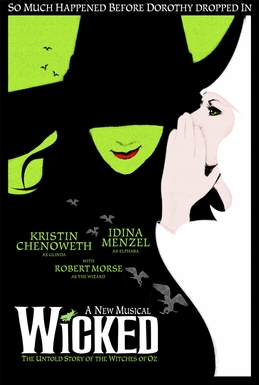
One of my favorite musicals (and no, I haven't read the book it's based on), Wicked helped inspire me as a writer. The writing, and how everything comes together is brilliant. Add this to a thrilling and wonderful score, and an amazing set, and of course you have an incredible musical. I first saw Wicked in London, then saw it on Broadway with Rachel for our one-year anniversary as a couple. While writing School of Deaths I'd play the soundtrack, imagining Suzie struggling at the College of Deaths, while Billy told her to simply try "Dancing Through Life." One of the characters in the novel, named Athanasius, was even given a goat-like physical appearance directly inspired by Dr. Dillamond.
| Elphaba and Dillamond- Original Broadway Cast |
Matilda: the Musical by Minchin and Kelly
When I saw Matilda, I posted on this blog that it was one of the best new shows I've seen (original post here). Like Wicked, this was a soundtrack I played while writing my first drafts of School of Deaths. I had read Dahl's book as a child, and the thing that thrilled me about the character Matilda was her love of books and reading. When I went to the RSC production in London and saw thousands of letter tiles exploding outward to form one of the best sets I've seen- I remembered how much Matilda liked to read. It reminded me of another child who always dove headfirst into books, and would spend entire summers devouring bookshelf after bookshelf. That child, of course, was me. One of the most important locations in School of Deaths, as well as the current novel I'm working on (a sequel called Sword of Deaths) is a library. It may seem redundant to emphasize reading within the pages of a book- but as fewer and fewer children read for pleasure (an unfortunate trend), where better to encourage reading than within a book?
Those three stories definitely helped inspire me. Next week, I'll examine different stories.
Don't forget that School of Deaths is available for pre-order now if you visit MuseitUp's website here. This past Saturday, I spent 3 and half hours filming a trailer (to be released later this month). This is a teaser (not the full trailer)
Sunday, February 2, 2014
Inspiration
Inspiration drives nearly every major facet of my life. I teach theatre because I find it to be one of the most inspiring forms of art. Taking a story and bringing it to life with a group of people is amazing. I especially love the organic nature of drama. When my play Stuck was performed, I had envisioned the entire work while I wrote it. I knew what (I thought) it would look like from start to end. The finished play was drastically different, but that was good, since so many different ideas were involved in creating a new and interesting piece of art. I do enjoy working with kids too. Children have the power to inspire me, and inspiring them is something I aim to daily (occasionally with some success).
I am marrying my soul mate, because every time I see or even think of her, I feel inspired. After dating unsuccessfully, and beginning to feel a bit like a character from a sticom (my summer drama students like to call me Ted Mosby), I was wondering if I'd ever find love. When I first saw Rachel, I was coming down an escalator. We'd arranged a date over the internet, but I only had pictures to go off. My initial reaction was "please let that be her- she's stunning," and it was. Every time I am with Rachel, I no longer feel writer's block or unmotivated, I feel inspired. She is also a writer, and has encouraged me to continue being my best. I look forward to the day when we can do book tours together.
| With Rachel at the Huntington Botanical Gardens, California |
| Barras Nose - taken from Tintagel Castle, Cornwall |
| Sunset over Rome, from Piazza del Popolo |
| Glastonbury Abbey |
| Guy Fawkes' Day in London - 2011 |
For me, meditation has been one answer. It helps me remain focused. Making sure I revisit natural places regularly, even if it's a simple walk outside, also helps. Spending time away from work and other stresses also helps me remain inspired.
Perhaps the key is actually recognizing inspiration. Anything can inspire us if we let it, from the news, to a "conversation" over twitter.
Perhaps inspiration isn't the act of journeying in search of a muse, it's the act of recognizing the muse in ourselves. Several years ago, I read Julia Cameron's excellent book The Artist's Way, which focuses on methods to reclaim your own muse. Shortly after reading it, I found myself recognizing inspiration in daily life. Stress can be a fog, but the light of inspiration is always there, once we look past the fog.
Again, I ask:
What Inspires You?
Subscribe to:
Posts (Atom)