As an acting and theatre teacher, I spend a lot of time working with young actors on discovering their characters' targets.
Depending on which acting methodology a person uses, they might refer to these as various things. A target encompasses a character's objective, their goal, and relates to their superobjective. I like the term target, first introduced to me in Declan Donellan's "The Actor and the Target" because it provides a concrete image of what you're aiming for when onstage. I strongly encourage all my actors to always have a specific target in mind. Acting is about doing, so every time an actor is onstage, there is something that they want, a target the character is working towards. For example, Romeo's target at the beginning of Romeo and Juliet might be relief, he vents to his friends about his girl problems. Later, his target becomes Juliet herself.
Thinking about targets is especially useful as a writer. Every writer has strengths and weaknesses. Personally, one of my greatest strengths tends to be creating memorable environments and locations. I can envision drastic, imaginative settings, and describe them well. However, setting is only one part of a story. One thing I've been doing lately, is when I'm crafting a scene I go through and take some time to check every single character's target.
Even in a battle scene with hundreds of characters, every single figure has their own unique target. Every one wants something, and will go towards that goal until they get it, or their target shifts. Characters can share targets, but I find it helpful to think of each character as an individual who wants specific, different things. One figure in a battle scene might fight for revenge, another to prove himself to a parent, and another for money. But they're all fighting on the same side.
Go through whatever you're working on. Do you know your main character's target on every page? Do you know the targets of every minor and background character? Try adding targets to make your writing more detailed.
Showing posts with label characters. Show all posts
Monday, June 15, 2015
Monday, March 17, 2014
Chutes and Ladders: Part Two
In my last post, I discussed the role of chance in our everyday lives. Today, I look at the role of chance in writing.
Today is St. Patrick's day. I remember as a kid, looking through our yard for a four-leaf clover. I never found it. When I was in kindergarten, my mother pointed to a rainbow in the sky, and told my brother and I that we'd go look for the pot of the gold at it's end. We jumped in the car, full of excitement, but never seemed to catch the end of that magical arc of colors. How many people look for a little token of control- something to change the roll of fate's dice in their lives, and reduce the amount of chance?
However, whether you believe entirely in chance or not, there's one arena where chance needs to be both absent and always-present: fiction. Perhaps the only place where there is no chance, no fate, and no luck at all is within the world of fiction. Getting published, or making lots of sales- that's a different matter. I'm referring to the world of the novel itself.
Like most authors, I started my novel with an abstract idea. This led to a rough outline, then a first, second, and third draft... eventually to line edits, content edits, and currently a galley review. There isn't a word in my novel that's in there by chance. There's not a single thought that hasn't been evaluated and studied, not just by me, but by my early readers, my editors, and my publisher. This novel, and indeed all novels, is meticulously planned out. However, it still needs to give the illusion of chance. I need my readers to believe that some of the events happening to the characters are random. If you want a storm to blow over your setting, for example, that storm needs to appear from nowhere. Or perhaps a character dies randomly- it happens in both real life and fiction, the difference is that fiction only appears random.
The method employed by Donwton works well in fiction as well. Engage the audience's attention thoroughly in the opposite direction you intend to take them. Then throw your curveball. If you truly want an event to seem random, avoid foreshadowing it, or keep foreshadowing to a minimum. You, the author, know what's around the corner, but you want the reader staring staring straight down the road. That way, when your plot twist comes leaping out, the reader is blindsided and thinks its purely chance. Keep in mind, however, that not every event is chance, even in your novel. Just like in reality, if there's an internal choice, it still should follow the character's rationale.
That's my thoughts on chance. I also have some major news for my novel. The cover is out, and I have a release date of May 2nd.
In preparation for this release, I have written a short story set two years before the novel. SHADOW OF THE SCYTHE- the story of a French boy brought to the World of Deaths. Download a FREE copy of Shadow of the Scythe at my website: http://www.christophermannino.com/free-reads.html
That's my thoughts on chance. I also have some major news for my novel. The cover is out, and I have a release date of May 2nd.
In preparation for this release, I have written a short story set two years before the novel. SHADOW OF THE SCYTHE- the story of a French boy brought to the World of Deaths. Download a FREE copy of Shadow of the Scythe at my website: http://www.christophermannino.com/free-reads.html
On a final note, if you enjoy chance- you now have an exciting chance to win a FREE copy of my upcoming novel School of Deaths (the full novel). This sweepstakes runs through April 1st.
Sunday, February 23, 2014
What's in a Name?
Like many first-time authors, I'm caught in the middle of two pulls. The excitement of landing a publishing contract and launching a writing career wrestles with the fear of remaining anonymous, the fear that none will read my novel. Though the book hasn't even been published, with a website in my name and increasing social media presence I decided to Google search myself. I was surprised.
| Who am I? |
I then started thinking less about my own name, and more about my characters. I;m not going to change my name, but every character name is completely up to me. In my first (unpublished) novel, I spent weeks and weeks agonizing over the perfect names. In my earliest drafts, characters would talk to NAME1 or NAME2, since I couldn't bear to label any of the figures permanently.
In School of Deaths, the main character was originally Billy Black. Black is a color associated with death and darkness, and I liked the alliteration. Billy is a name for a kid, a fun name. Then I switched the novel so it was told from a girl's perspective. I'm not completely sure where Suzie Sarnio emerged from as a name, perhaps a tribute to my own Italian heritage.
Sometimes naming a character appropriately can be strange. In School of Deaths, a minor character is a figure called Athanasius. Athanasius is a goat-like figure who welcomes Suzie to the College of Deaths. His eyes are yellow like a lizard's, his face and hands look like a goat. He is the first Elemental Suzie meets; the Elementals are one of the major species in my world. After naming him, I went to see an eye specialist. The doctor's name, as he greeted me, was Athanasius. As the ophthalmologist examined me, I couldn't help but envision a pair of yellow lizard eyes staring at me, and hands like a goat's....
How do you name characters?
Saturday, February 15, 2014
Wants and Goals
As Valentine's Day rolls by I turn my attention to desires.

For many years, one of my greatest wishes was to find love. Like many singles, I used to spend Valentine's Day utterly miserable, trying to ignore all my dating friends. I'd pretend I didn't see the glut of commercialized "love" shoved at everyone through TV, movies, and the internet.
I am fortunate enough to have found my soul mate. In fact, this was the best Valentine's Day I've had so far. Thanks to a snowstorm and President's Day, Rachel and I enjoyed a full 5-day weekend together. We made homemade chocolate-dipped strawberries, had dinner at one of our favorite restaurants, enjoyed an in-home couples' massage, and best of all we wrote our wedding vows. My goal of finding love has come true.
For Young Adults, both in reality and in fiction, goals and wants are not always straightforward. As an author and teacher, I think it's important to note how many kids have goals that are forced on them by parents, peers, or even society. The school where I work is a particularly strong example. Roosevelt is a science and tech magnet school for the entire county. It has a huge arts program, including the massive theatre department I run, but ultimately most of the top kids who attend the school do so to take part in the advanced science courses. It is not a vocational school, but does provide intensive internships at places such as NASA (which is a block up the street), the National Institutes of Health, the FDA and other federal research facilities around the DC area.
Every kid has at some point been asked the question "what do you want to be when you grow up?" Personally, I think it's a terrible thing to ask, especially to younger kids. Who really knows their career path as a kid? Still, it's such a cliche question, I ask it myself. Before I started teaching at Roosevelt the answers I'd hear were usually along the lines of "I dunno, maybe a lawyer." Now, I hear "I plan to specialize in bioengineering and microecology." You're fifteen, I respond in my head.
However, that's just the problem. The better I get to know my students, the more I'm realizing that they say they want one thing, but in truth have no idea. Society today has moved far away from the idea of a person going to college with one major, getting one internship or apprenticeship, and working one career until retirement. I don't actually know anyone in my generation who has done that, yet our schools are becoming more and more geared towards this antiquated ideal. Now, students are required to take large numbers of their college courses while in high school (AP Courses), they often have to apply to extremely restrictive majors, and if they don't go to college, their parents and some of their teachers will emphasize their lack of success. What are we teaching kids? We're ultimately forcing them to have goals, whether they're ready to or not.
Of course a goal is not the same as a want. Perhaps the question shouldn't be what do you want to do when you grow up, but rather what is the goal you are currently adopting for yourself. For example, one of my students came to me very upset two weeks ago. She is a strong actor, and had told me how much she wanted to keep acting, even if it was just for fun. Acting and theatre was a true want, something she desired to do. Her parents wanted her to stop acting, since the time it took was interfering with what they wished her goals to be. Her goal was to have a successful career and be happy. Ultimately, goals need to intersect with our wants to be successful.
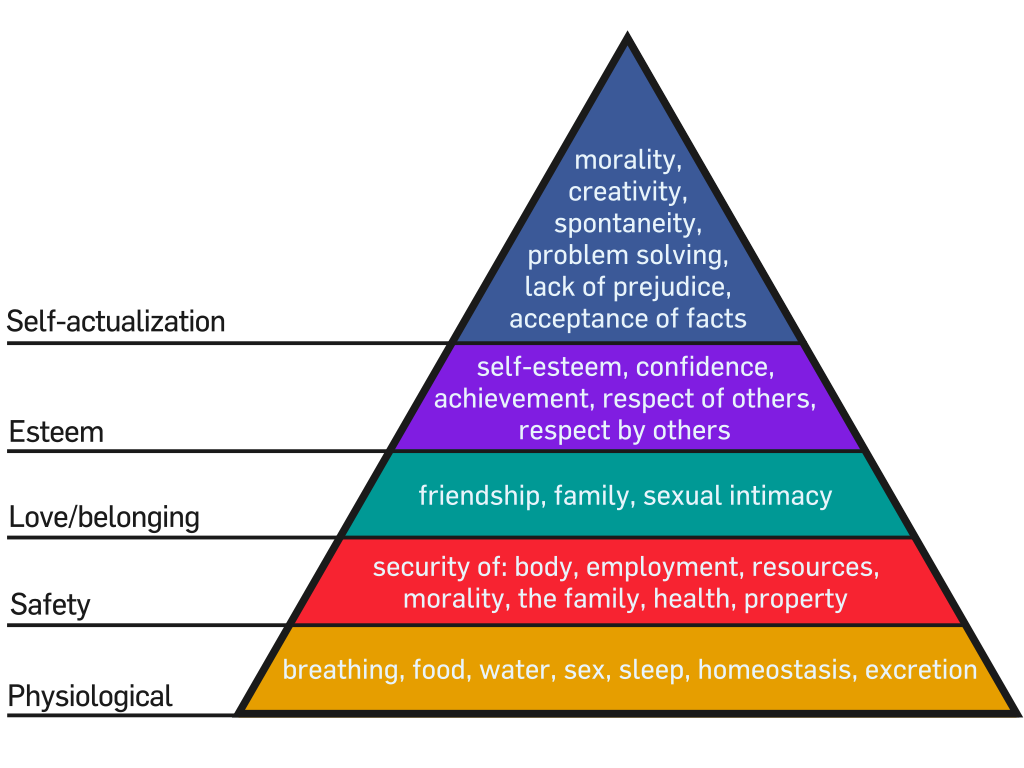
When writing YA characters it's important to keep the characters' goals and wants in mind, but recognize how severely society (or whatever the situation of your story might be) will impact them. It seems that often we ignore our own wants in pursuit of our goals. One must also keep needs (a separate category entirely) in mind. In my upcoming novel School of Deaths, Suzie's primary goal for much of the novel is to go home. Yet she soon finds herself in situations where other needs take precedent. Safety is a basic need, and when Suzie's safety is threatened, going home becomes a want, while finding safety becomes her current goal. Maslow's famous "hierarchy" works just as well for fiction as it does for life, with needs on the bottom of the chart needing to be met first:
Goals will shift in a novel and in life. To return to the question of what to do when you grow up, I've now noticed that students will answer differently depending on who they are with. The answer they give me when alone will be different than if a parent is standing there, and different again if in front of their friends. This isn't necessarily deceptive, since a child's goals for one group might be different for another. This too should be kept in mind when developing a YA character. The goals they relate, and even believe in, are dependent on their circumstance and situation, yet should remain consistent nonetheless. This is a simplification of life. It is expected in fiction, but in life doesn't always follow. For example, Suzanne Collins' character Katniss has several goals throughout the Hunger Games novels, yet the goals almost always relate to protection (protect her sister, protect herself, and eventually protect society itself from a corrupt government). Katniss is a strong character because her goals remain consistent. Do actual teens remain consistent in their goals or wants? Often the answer is an absolute no. If that is the case, perhaps fiction is one way even our authors are trying to encourage kids to stick with one goal, and one path. I don't agree with it in life, yet I find myself drawn to the same conventions in my writing. I like my characters to stay strong, and to remain consistent with the types of goals and wants they pursue.
To avoid having a character desire the same goal in every situation (something no true teen would do), I think it's helpful to write out a separate goal sheet for each character and break it into circumstances. Roald Dahl's Matilda for instance has a very different goal in mind when dealing with Trunchbull than she does with Ms Honey, and a separate goal set again when dealing with her parents. When teaching acting we focus on objectives and superobjectives that a character has in every scene. Goals and wants are not much different, the one important detail to remember with kids is that they're rarely truly sure. In a sense kids are trying goals as they mature. Ones that work are kept, ones that don't are abandoned. The closer a goal is to the kids' wants or basic needs, the more passionately they'll pursue the goal, and the more a goal is instilled from an external source, the more likely they are to abandon it at some point.
With that in mind, back to my next goal: more writing!
Subscribe to:
Posts (Atom)